
Mississippi Court Docket Searches
Start with the paper in hand. Read the citation, summons, notice, or order, and write down the court and county. Circuit, Chancery, and County Court records live in Mississippi Electronic Courts (MEC), with public access through Public Access to Mississippi Electronic Courts (PAMEC). Justice Court and Municipal Court dockets stay local. A case number narrows a docket search fast. But the PAMEC search workspace opens only after registration, so the exact fields and filters may differ from what a visitor sees before signing in.
- Identify the court named on the case paper. A lower-court ticket may not be in MEC.
- For a Circuit, Chancery, or County Court matter, open the official MEC program page and follow its PAMEC registration route.
- Review the non-attorney terms before searching. Result pages can be charged even when a search finds no case.
- Use the case information requested by the live portal, then read the docket entry with its date and context.
- For a full document, certified copy, older file, or local-court case, contact the clerk that holds the record through the Mississippi county directory.
Treat any result as a lead, not a verdict. A hearing date listed online can change, and a docket line can read unclearly. When a court date is near, call the clerk to confirm the current entry and any order behind it.
Inside the Mississippi Public Search
PAMEC is the remote public doorway to eligible records held in MEC. Registration comes first. The registration terms and choices cover Attorney, Non-Attorney, and Firm Administrator accounts. Read them before signing up. This is not an anonymous, no-login search. The public registration screen does not show the signed-in case-search workspace. Its field labels, county and court menus, date limits, sorting, and result pagination should be read from the live interface. Do not guess them.
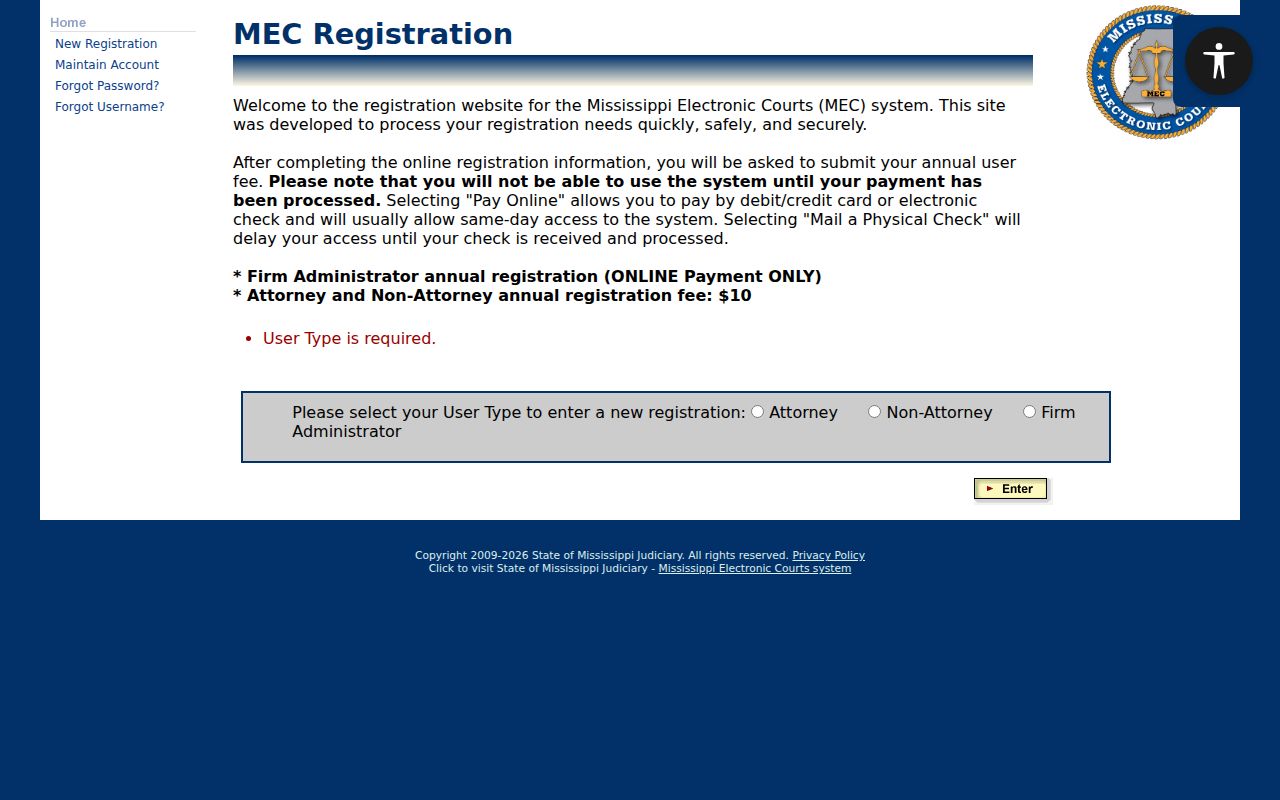
Signing up is only the access step. The portal's terms govern search charges and permitted use, while the clerk who holds the record stays the source for certified papers and case questions. A public terminal at a court location offers another way to view covered MEC records without remote result-page fees. Copying and certification remain clerk transactions either way.
| Search stage | Visible information | Limit |
|---|---|---|
| Account registration | Attorney, Non-Attorney, or Firm Administrator account choice | Registration is required before PAMEC case search. |
| Case-search fields | Not observable in the public pre-login screen | Field labels, county menus, and required options are not asserted. |
| Public-use terms | $10 annual non-attorney charge; $0.20 for each results page | A no-match search still generates one billable page. |
Enter a known case number or other reliable case detail where the live form allows. PAMEC terms prohibit automated harvesting. Broad, repeated searches can pile up charges without producing a useful answer, so keep the docket lookup narrow.
The Statewide Case Search in Mississippi
MEC is Mississippi's case-management and e-filing platform. It serves Circuit, Chancery, and County Courts, plus the appellate courts. PAMEC gives eligible public users remote access to records the system makes available. The two names mark different paths. MEC is the court-side filing system; PAMEC is the public-facing route in. A portal result can point to case activity. Yet the complete docket sheet, older paper file, or certified order may still require the clerk who keeps the record.
Mississippi has no single public docket search covering every court tier. The statewide index does not replace the local route for Justice Court traffic and misdemeanor cases. Nor does it cover Municipal Court ordinance matters. If the court on a citation is one of those lower courts, contact it directly. For the trial-court map and the flow from clerk to index, see Mississippi's court structure. For statewide search steps and access limits, use the Mississippi docket search page.
Public access has boundaries too. Youth Court files, sealed matters, and records under a protective order may be omitted. Some may be partly restricted. A blank result does not prove no case exists. It can mean the court sits outside MEC, or the file predates local electronic use. It can also mean the record is not public, or the search terms do not match.
Mississippi’s Statewide MEC Rollout
The shared system arrived in stages. Mississippi's judiciary says MEC pilot activity began in Madison County Chancery Court in 2008. Chancery Courts reached statewide deployment by June 19, 2023. The Administrative Office of Courts announced on July 2, 2025 that implementation had been completed in every Circuit Court location, all 24 County Courts, and both appellate courts. June 30 served as the statewide completion date for the latter groups.
That milestone means the listed courts share one filing and case-management backbone. It does not mean every lower court joined. Not every past paper file was scanned, and the public does not see each document without a login or fee. Launch dates differed court by court. The state has not published a uniform date from which all historical records are online. So a clerk can say whether an older file sits in paper storage or was added to MEC.
The statewide announcement describes court coverage, not an individual-case search guarantee. Mississippi searchers still need the court name and county. That tells them what an online result can show.
Mississippi Courts and Their Dockets
Mississippi sorts its trial courts by subject and claim. Circuit Court is the general-jurisdiction workhorse. Chancery Court takes equity, family, probate, and land matters. County Court exists in only 24 counties. Justice Court sits in every county, and cities may run their own Municipal Court. Above them all, the Supreme Court and the Court of Appeals hear appeals under separate case numbers and separate records.
| Court | Docket Covers | Where to Search |
|---|---|---|
| Circuit Court | Felonies, major civil cases, and appeals from lower courts | Circuit Clerk; eligible records in MEC/PAMEC |
| Chancery Court | Family, probate, equity, land, guardianship, and related matters | Chancery Clerk; MEC/PAMEC with access limits |
| County Court | Limited civil, misdemeanor, youth, and appellate work where established | Circuit Clerk; MEC/PAMEC |
| Justice Court | Claims up to $3,500, misdemeanors, and many traffic cases | Local Justice Court, outside statewide MEC coverage |
| Municipal Court | City ordinance, traffic, and misdemeanor matters | Issuing Municipal Court and its local clerk |
| Supreme Court and Court of Appeals | Appellate cases, briefs, orders, and opinions | Office of the Supreme Court Clerk; appellate route |
Need current districts, assignments, judges, or contacts? The 2026 Judiciary Directory and court-term publications are the place to start. A directory can tell you where a court sits and who serves on it. It cannot show each case's live hearing date. That job belongs to the docket, which tracks one case's event history from filing onward.
Mississippi Clerks Keep Separate Records
Mississippi has no single county clerk holding every docket. The right office depends on the court named on the filing. Circuit Clerks keep Circuit Court and County Court records. Chancery Clerks hold Chancery Court files, covering family, probate, land, and equity matters. Justice and Municipal Court dockets stay with those lower courts, where local arrangements differ. Appellate filings go through the Office of the Supreme Court Clerk.
This split explains many dead-end searches. A PAMEC view may help you find an eligible case. But questions about a correction, a certified copy, an older file, or the paper behind an entry belong with a Circuit or Chancery Clerk. A city ticket or Justice Court matter may never reach the Circuit Clerk at all. Pick the county in the directory. Then follow the court name printed on your notice to the right office.
Some clerks also carry broader county duties beyond court records. When you request a docket, name the court and case type. Include the case number if you have it, plus the filing year and the specific paper or entry you want. Never assume a person's home county points to the courthouse that filed the case.
Inside a Mississippi Court Docket
A Mississippi docket sheet lists a case's filings, settings, and court actions in order. It shows what happened and when. It is not the full case file. Note that the public PAMEC registration screen does not display the signed-in docket view. The common docket fields help you identify a case and follow its events. Exact labels vary from court to court.
| Case number | A court-assigned identifier for one proceeding; format can differ by court and filing year. |
|---|---|
| Parties | Names or roles of the people or organizations in the case, subject to redaction or access limits. |
| Filing or event | A chronological entry such as a complaint, motion, notice, order, hearing, or judgment. |
| Setting | A scheduled appearance, hearing, docket call, or trial; later entries may change the date. |
| Disposition | A recorded procedural outcome; the signed judgment or order gives the exact effect. |
| Document | The filed paper or PDF behind an entry, which may require a separate view or clerk request. |
A search result, a docket printout, and a certified copy are three different things. If you need the text of a ruling, request the order by date or title from the office holding the file. Mississippi clerks can explain how to order a copy. The public search result itself does not certify anything.
Mississippi Docket Terms in Plain Words
Mississippi docket entries use shorthand for the steps in a case. A short entry rarely explains why the court acted. It also rarely says what a party must do next. Abbreviations differ by locality. Read each entry next to the order or notice behind it. Ask the clerk to identify any filed document whose meaning is unclear.
- Setting
- A scheduled court appearance, hearing, or trial event.
- Continuance
- A postponement of a hearing or trial to a later time.
- Reset
- A matter has been rescheduled, sometimes with the new date in another entry.
- Disposition
- A recorded outcome or procedural resolution; the judgment gives the exact result.
- Remand
- An appellate court sends a case back to a lower court for further action.
- Sealed
- A record or part of a record is restricted under an order or law.
A docket call is a session where the court calls or manages cases. A notice of appeal opens a separate appellate proceeding. Neither entry is a final judgment on its own.
How a Mississippi Docket Reaches MEC
A Mississippi case starts in a court that has jurisdiction. An authorized person files it, and the clerk or court staff process the filing in the case-management system. Accepted papers and later actions are recorded as the case proceeds. MEC supports e-filing and case management in Circuit, Chancery, and County Courts; PAMEC shows eligible information to registered public users. The path can be summarized as: County filing → clerk processing → court docket → eligible statewide public view.
The state index sits on top of a court record; it does not correct one. The clerk answers filing questions. The clerk also pulls old paper records, issues certified copies, and handles case-specific access. Justice and Municipal Courts are not part of the statewide MEC system. Their dockets remain local. Appellate courts joined the electronic system. Yet their cases still run through a distinct clerk process.
Mississippi makes no uniform real-time or nightly refresh promise for the portal. A new filing must be accepted and docketed before it shows in a public view. For an urgent date or a freshly submitted paper, call the court. Do not trust a portal display as a live guarantee.
Docket Access Laws in Mississippi
Mississippi keeps judicial records separate from records of other public bodies. The Mississippi Public Records Act of 1983 governs bodies subject to that law. But it is not the usual route for requesting a court file. Instead, the Mississippi Supreme Court adopted its own policy. That policy sets the openness and availability of judicial records. Access also turns on court rules, sealing orders, redaction requirements, and statutes protecting certain case types.
Key Mississippi access rules:
Miss. Code Ann. §§ 25-61-1 et seq. establishes the Mississippi Public Records Act for covered public bodies outside the judiciary’s case-file process.
Mississippi Supreme Court public-records policy governs requests for judicial-branch records and recognizes access limits under rules and orders.
Miss. Code Ann. §§ 43-21-257, -261, and -263 provide confidentiality, authorized access, and sealing rules for Youth Court records.
When a case file is restricted, ask the office holding it to name the rule or order behind the limit. Ethics Commission guidance on the Public Records Act can help with nonjudicial records from covered agencies. It should not be used to promise a court clerk a PRA response deadline or appeal route.
Youth Court Records Have Limits
Mississippi Youth Court files sit on their own access track. Statutes and the Uniform Rules of Youth Court Practice guard their confidentiality. They cap who may inspect them, and they allow sealing. A case may run through a County Court or a Chancery Court. Yet that local setup never converts the file into an ordinary public criminal docket. If a PAMEC search comes up empty, treat that silence as protection. It is not a clue about a youth or a case result.
Other sensitive filings face limits too. A statute, a redaction rule, or a judge’s order can hold back part of a file. A family case might show public docket entries while an attachment or personal identifier stays withheld. When a record is missing online, ask the clerk which provision controls. Ask too whether a public redacted copy exists.
Some requests need judicial permission. Those go to the court that imposed or administers the restriction. And remember the Public Records Act works in a different access setting than court policy. A Youth Court question belongs with the local court administrator or clerk. It does not belong with an executive-branch channel.
What Mississippi Caseload Data Shows
Caseload numbers need a year attached. A 2024 redistricting analysis pulls its values from the Supreme Court’s 2022 annual report. That report counted 55,839 Chancery cases across 20 districts and 34,637 Circuit cases across 23 districts. It also estimated averages of 1,074 Chancery cases per judge and 630 Circuit cases per judge. Those averages draw on 52 and 55 judges respectively. Circuit’s per-judge average broke into 322 civil and 308 criminal cases.
Read these as 2022 figures. They are not a current filing count, and they forecast nothing for a single county. The same analysis flagged that the newly created 23rd Circuit District had no annual caseload data yet in its source year. A district boundary change can make year-to-year comparison misleading. For newer totals, check the Supreme Court annual reports, archived through 2024.
The two totals also measure different work. Chancery handles family, probate, equity, and related matters. Circuit handles major civil cases, felonies, and other assigned work. A docket search still turns on the case and its court, not a statewide statistic.
Mississippi Court Dates Depend on Place
Ten Mississippi counties have two county seats, per the Mississippi State University Extension county-government guide. That geography matters when you read a notice. A county name alone won’t tell you which courthouse holds the hearing. It won’t reveal the clerk counter or term location either. The current 2026 directory and court calendars list district assignments, judges, contacts, and court terms.
Don’t confuse a court term with a case setting. Circuit and Chancery term publications show when courts sit in a district. They do not show each party’s hearing date. Pull the individual docket and the most recent notice. Then call the court clerk or coordinator if the setting is near, changed, or unclear. Justice and Municipal Court calendars stay local.
The county directory is the route to local offices and court sites. Use a term calendar to learn when a district court sits. Confirm any specific hearing date with the court that holds the case.
Mississippi Court Dockets by County
Docket sheets and official copies live at the local court level. So the county where the case was filed is your practical next step. These six featured entries cover Mississippi’s largest counties by the guide’s 2022 population table. The counts give population context, not court volume. Each card opens the county hub for local court and clerk routing.
Hinds County
Jackson and Raymond · 217,730 residents in the 2022 table; two county seats
Harrison County
Biloxi and Gulfport · 211,044 residents in the 2022 table; coastal county with two seats
DeSoto County
Hernando · 191,723 residents in the 2022 table; part of the 23rd Circuit District
Rankin County
Brandon · 158,979 residents in the 2022 table; fourth largest by population
Jackson County
Pascagoula · 144,975 residents in the 2022 table; Gulf Coast county
Madison County
Canton · 111,113 residents in the 2022 table; early MEC Chancery pilot
Open the full directory of all 82 Mississippi counties to reach the local court route for any county.