
How Mississippi Courts Are Organized
Mississippi runs two appellate courts above its trial courts. The Supreme Court sits at the top. The Court of Appeals handles intermediate appeals assigned to it. Below them sits Circuit Court. It is the main general-jurisdiction trial court for felony cases, major civil matters, and many appeals from lower courts. Chancery Court takes equity, family, probate, land, and related statutory matters. County Court exists in 24 counties and handles limited civil, misdemeanor, youth, and appellate work.
Justice Courts sit in every county and hear smaller civil claims, misdemeanors, and traffic matters. Municipal Court covers city ordinance, traffic, and misdemeanor cases within municipal authority. Youth Court has its own statutory jurisdiction and strict confidentiality rules. Whoever holds the docket depends on the court type, not on one statewide clerk's office.
| Court level | Common role | Record route |
|---|---|---|
| Supreme Court and Court of Appeals | State appellate review | Office of the Supreme Court Clerk and appellate docket route |
| Circuit Court | Felony, major civil, and lower-court appeals | Circuit Clerk; eligible MEC/PAMEC records |
| Chancery Court | Family, probate, equity, land, and related cases | Chancery Clerk; eligible MEC/PAMEC records |
| County Court | Limited jurisdiction in 24 counties | Circuit Clerk; eligible MEC/PAMEC records |
| Justice and Municipal Courts | Local civil, ordinance, misdemeanor, and traffic matters | Issuing court and its local clerk |
How the Administrative Office Supports Mississippi Courts
The Administrative Office of Courts (AOC) supports the Mississippi judiciary with administration, research, education, technology, statistics, and court services. It works under Supreme Court direction. Its statutory framework sits in Miss. Code Ann. §§ 9-21-1 through 9-21-101. That statute also assigns duties to the director. AOC runs statewide court infrastructure. It does not hold a county case file. It cannot issue a clerk-certified copy of any trial-court record.
That split tells you where to take a question. The MEC helpdesk deals with system access. A Circuit Clerk, Chancery Clerk, or lower-court clerk handles the filed case, a docket entry, a copy, or a hearing date. For statewide court information, the Mississippi AOC and the Mississippi Judiciary both publish details online.
Administrative Office of the Courts
Statewide court administration and technology support under the Mississippi Supreme Court.
601-576-4630
Note: AOC provides statewide support, and each court clerk keeps the record for a filed case.
Mississippi's Circuit and Chancery District Map
Mississippi groups its counties into 23 Circuit judicial districts and 20 Chancery districts. Circuit and Chancery terms calendars list the districts and the counties assigned to each. A district is an administrative grouping, though, not a statewide case database. The court's name matters most. The county on the case paper matters too. They remain the best keys for finding a docket. County Court exists in 24 counties, and Justice Court operates in all of them. For judge assignments, clerk contacts, county mappings, and terms, turn to the Secretary of State. Its 2026 Judiciary Directory and Court Calendar is the current source. The county directory then takes you from the district map down to local clerk information.
This structure means one county can hold records across several court tiers. A family filing, a felony prosecution, a local ticket, and an appeal may sit with different custodians. That can happen even in the same county.
The Statewide Portal for Mississippi Cases
Mississippi Electronic Courts (MEC) is the case-management and e-filing platform for Circuit, Chancery, and County Courts. The appellate courts use it too. Public Access to Mississippi Electronic Courts (PAMEC) is the remote route to eligible electronic case records. Registration is required. Non-attorney terms list a $10 annual account fee. There is also $0.20 for each search-result page, and a one-page no-match result counts as a page. The public search workspace sits behind a login. So its fields and court selectors are not described here.
The MEC deployment does not include Justice or Municipal Court dockets in the statewide completion announcement. Appellate filings go through MEC, but appellate public access runs on a separate docket route. The Mississippi docket search lays out the public case route and its limits.
| Court system | MEC/PAMEC coverage | Public access boundary |
|---|---|---|
| Circuit Court | All 82 Circuit locations by June 30, 2025 | Older file range varies; clerk holds the official record |
| Chancery Court | All Chancery Courts by June 19, 2023 | Sealing and statutory limits apply to some records |
| County Court | All 24 County Courts by June 30, 2025 | County Court exists only in 24 counties |
| Appellate courts | Included in the statewide implementation release | Separate public docket presentation and clerk route |
| Justice and Municipal Courts | Not listed as MEC trial-court participants | Contact the court printed on the notice or citation |
Mississippi Circuit and Chancery Clerks
For Circuit Court and County Court records, the Circuit Clerk is the contact. The Chancery Clerk keeps Chancery Court records covering family, probate, equity, and land matters. These jobs do not overlap. A case paper naming Chancery Court means a Circuit Clerk's PAMEC search may not answer questions about that Chancery file. The reverse holds too. Justice and Municipal Court records stay with the local lower court. Youth Court may sit inside a County or Chancery Court structure. But confidentiality rules apply no matter which office supports it. An appeal is its own proceeding. Its own docket is kept by the Office of the Supreme Court Clerk.
- Circuit Clerk
- Maintains Circuit Court and County Court case records.
- Chancery Clerk
- Maintains Chancery Court case records and related filings.
- Local court clerk
- Handles Justice or Municipal Court records under local arrangements.
The 2026 judicial directory lists statewide and local judicial contacts. The county directory links to the local layer, since no single county office represents the whole system.
Note: The clerk name and court label on the case paper decide which Mississippi office holds the file.
Justice and Municipal Courts Stay Local
Not every Mississippi court sits inside the statewide public search. Justice Courts take traffic and misdemeanor matters county by county. Municipal Courts handle cases that fall under city authority. The statewide rollout announcement names Circuit, Chancery, County, and appellate courts as the participants. It leaves Justice and Municipal Courts off that trial-court list.
Got a ticket? Use the court printed on the citation. For any other lower-court case, check the notice or a prior order. It tells you which clerk holds it. A blank PAMEC result can simply mean the case sits in a court outside that coverage. It does not mean the ticket was dismissed or that no court record exists. Turn to the Mississippi county directory for county contacts. For a city ordinance matter, contact the municipality's own court.
From County Docket to Mississippi Index
Every case starts in the court with jurisdiction. In a Circuit, Chancery, or County Court matter, the clerk and court run the filings and case events through MEC. PAMEC then lets the public reach eligible information and documents from afar, subject to registration, fees, privacy limits, and the record's status. Keep the shape of this system in mind: it is one shared court platform, not a daily batch that copies a whole county file into a separate index.
Case flow: Filing accepted by the court › clerk and court record events in MEC › PAMEC displays eligible public records; lower-court Justice and Municipal records remain with the local court.
The clerk stays the source for real fixes. Corrections, recent actions, older paper files, and certified copies all run through that office. An appeal adds a new case number and docket of its own. When the statewide view falls short or you need the original file, use the county directory to reach the local court layer.
Note: The county-to-state path describes a shared system. It promises neither instant posting nor full public access.
How MEC Feeds the Docket
MEC is Mississippi's centralized e-filing and case-management system, patterned on the federal CM/ECF platform. Its rules live in the MEC Administrative Procedures. Those procedures cover accounts, electronic filing, service, and court workflow. Lawyers and other authorized users file through MEC in participating courts. A public PAMEC account only grants access; holding one does not make you an e-filer.
Court staff and judges use the same platform. They manage filings and case activity there, and they receive e-filings through it. A filing must be accepted and processed. Only then does the event show up in the public record. The judiciary has not published a statewide refresh interval or any promise of instant display. Wondering whether a filing was accepted? Ask the clerk or court directly.
MEC support handles login and account trouble, and it is separate from the clerk's office. Case questions belong to the court that holds the record. Copy requests, hearing dates, and access decisions belong there too.
Mississippi PAMEC Access Fees and Docket Limits
PAMEC is no anonymous free search page. Non-attorney public use costs $10 per year plus $0.20 for each page a search generates. Even a search with no match still creates one billable page. Billing runs quarterly under the published terms. Pages are charged whether or not you open, print, or download each result. The terms also bar automated harvesting.
You can dodge the remote search-page charge by using the public terminals at court locations. Those terminals let you view covered MEC records in person. Copying and certification may still carry fees. The public workspace requires sign-in. So never assume a particular search filter, date range, or county dropdown exists there. If a result seems missing, stale, or restricted, ask the holding clerk.
Judicial files follow their own access policy. The Mississippi Public Records Act governs records held by public bodies under that law. But it is not the general request rule for court case files. Judicial records answer to the Mississippi Supreme Court's judicial public-records policy. Court rules, statutes, and orders apply as well. Do not lean on the Ethics Commission's PRA guidance. It will not promise a court clerk a statutory deadline or appeal route.
The official PAMEC non-attorney terms spell out the charges and user rules. Account fees never replace separate clerk fees for a document or certified copy.
Statewide Index vs Mississippi County Docket
Two layers serve different jobs here. PAMEC exposes eligible electronic docket information and documents across participating courts. The holding clerk keeps the official court record. That clerk answers file questions, issues certified copies, and holds paper material the system may not carry. A search result never replaces an authenticated copy of an order or judgment.
| Need | Statewide PAMEC view | Holding court or clerk |
|---|---|---|
| Locate an eligible electronic case | Remote access after registration and applicable fees | Can confirm which court has the file |
| Read a docket event | Shows public entries and available documents | Can explain an entry or identify its filed document |
| Older paper record | May not include a scanned historical file | Can check local retention or archive status |
| Certified copy | Remote view is not clerk certification | Request from the clerk who holds the official record |
For Mississippi court records, pick the county and court first. Then route your request to the proper office through the county directory. Federal cases and DPS records run through separate systems as well.
Note: An online docket view does not certify an order or judgment. The certified version sits in the Mississippi case file.
Mississippi Court Caseload Figures Need Their Year
Any Mississippi court caseload figure needs a year attached to it. Without that label, a number can masquerade as current when it is not. A 2024 judicial-redistricting analysis pulled its counts from the Supreme Court's 2022 annual report. It listed 55,839 Chancery cases spread over 20 districts, plus 34,637 Circuit cases across 23 districts. To get district averages, the analysis divided by the judges listed for those courts, not by cases per county. So treat those totals as 2022 figures rather than live docket counts for this year.
One wrinkle deserves mention. The new 23rd Circuit District had no annual caseload data in the source year. Chancery and Circuit also do very different work. A Chancery filing count and a Circuit criminal count cannot be compared head to head. For dated context, start with the Mississippi 2024 district analysis and the Supreme Court annual-report archive. Neither offers a running docket tally.
How Mississippi Courts Went Digital
Mississippi's electronic filing system took nearly two decades to build. Planning for MEC started in the mid-2000s. In 2007 the Supreme Court partnered with the federal judiciary to study electronic filing approaches. A pilot followed in Madison County Chancery Court in 2008. Harrison County Circuit and County Courts came aboard early in 2011. Chancery deployment then reached every court of that type by June 19, 2023. By June 30, 2025, the statewide system covered all Circuit Court locations. It also covered all 24 County Courts. Both appellate courts came in too.
An administrative backbone came earlier. The Administrative Office of the Courts opened on July 1, 1993. It still supports the judiciary's administration and technology work. This slow build explains why local go-live dates vary. Older files may not match newer ones, even now that participation is statewide. A court's rollout date never promised that paper records were scanned.
The judiciary's July 2025 MEC implementation announcement marks the systemwide milestone. For the platform itself, the MEC program information describes how it works. It also covers how the system developed.
Mississippi's Rollout Did Not Digitize Every File
Statewide deployment means MEC now manages current cases in the announced courts. It does not mean every old paper file was scanned. Each docket event may not post instantly. Not every court tier opens up in PAMEC. Local go-live dates differed from county to county. The judiciary publishes no single historical cutoff and no universal public refresh interval.
So a missing case is not the end of the road. Check the court type, the county, the filing year, and the public-access status. A local court-information page may spell out that court's own rollout history. One court's page never guarantees statewide coverage.
The MEC court information page shows how a local court presents its system details.
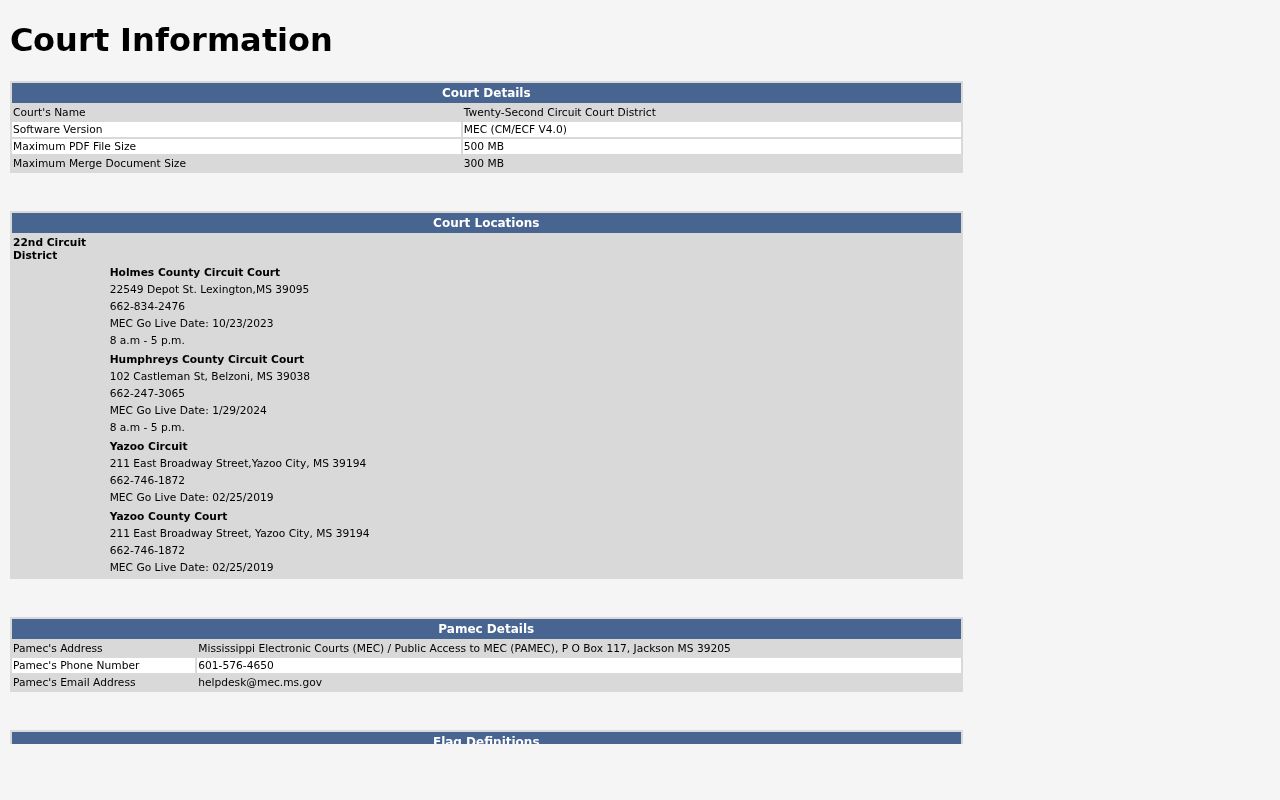
For a case-range question, a paper archive, or a fresh docket event, call the local clerk. Justice Court and Municipal Court matters go to the court named on the paperwork itself.
Note: Local implementation dates do not establish a uniform historical cutoff for Mississippi paper files.