
How the Mississippi Case Search Works
Mississippi Electronic Courts, known as MEC, runs case management and e-filing. It serves Circuit, Chancery, and County Courts plus the appellate courts. The public reaches it remotely through Public Access to Mississippi Electronic Courts, or PAMEC. The judiciary's MEC program page explains the system. Public users register at the PAMEC registration page. You need an account for remote case searching. Justice and Municipal Court dockets are outside the statewide MEC trial-court coverage.
Check the case papers first. Note the court and county before you open a Mississippi case search. The path below separates verified access steps from controls you can only see after sign-in.
- Read the court name, county, case number, and filing period from a notice, citation, or order if you have one.
- For Circuit, Chancery, County, or appellate matters, start with the judiciary's MEC page and follow its public-access route to PAMEC.
- Choose the account type that fits your role and accept the live terms before searching. Public registration lists Attorney, Non-Attorney, and Firm Administrator.
- If the account offers a case-number or party-name search, follow its current prompts. The exact search fields and filters were not observable before login.
- Review any available case header or docket entries. Request the underlying filing or certified copy from the clerk who holds the Mississippi case record.
Collect the case details you have first. The table marks helpful clues and separates them from PAMEC controls that its public registration screen does not show.
| Search Detail | Why It Helps in Mississippi | PAMEC Screen Status |
|---|---|---|
| Case number | Using it when known can narrow the search and reduce uncertainty. | Exact field label and required status not observable. |
| Court and county | Identify the court tier and the local record holder from the case paper. | County or court dropdowns not observable. |
| Party name | May help a clerk locate a case when a number is not available. | Name-search field and match rules not confirmed. |
| Filing period | Can help distinguish a current MEC record from an older paper file. | Public date filter not observed. |
| Account type | Registration offers Attorney, Non-Attorney, and Firm Administrator choices. | Visible on the registration page; it is not a case filter. |
Mississippi PAMEC Search Fields Require Login
The public PAMEC entry point presents registration and terms, not an anonymous statewide search form. The case-search workspace lives behind an account. So the statewide material cannot say whether the search accepts exact or partial names, middle initials, a filing-date range, or a county selector. Those details may change in the live system. The controls after login are the ones that matter.
The same limit applies to promises about Mississippi search results. PAMEC terms name case-header information and calendar-event reports. The case-level display itself appears only after sign-in. A public entry may expose only what that record permits. A case that does not come back is not a dead end. Check the court type and filing period with the right clerk. Do not blame the name or number.
Note: Mississippi's public portal requires registration. The case-search workspace and its field labels can be seen only after that step.
Searching Mississippi Cases by Number
A Mississippi case number is the clearest identifier. Give it to the court, or type it into a live PAMEC search. Copy the exact case number from the notice, order, or case caption. Keep every letter, punctuation mark, and leading zero. Formats vary by court and filing year. No single statewide pattern can be decoded. A guessed prefix is never a stand-in for the court name.
Some older cases predate a court's move to MEC. No universal backfile-conversion date exists. If a number returns nothing, confirm the filing year and court with the clerk. A trial-level appeal also gets its own appellate proceeding and identifier. Keep both numbers when a case moves up to an appellate court.
MEC Reached 188 Mississippi Court Locations
The Mississippi judiciary's July 2, 2025 rollout announcement marks statewide implementation. It covers all 82 Circuit Court locations, all 24 County Courts, every Chancery Court, and both appellate courts. That rollout reaches 188 Circuit, Chancery, and County Court locations in all. For a Mississippi case search, the change matters. Participating courts share one case-management and e-filing backbone.
Coverage is not the same as completeness. Justice Courts and Municipal Courts are not MEC trial-court participants. Local implementation dates differed. No statewide historical cutoff applies. Paper files may still sit at the courthouse. A missing entry can reflect court type or record age rather than a failed rollout. The Mississippi court structure page shows how the tiers differ.
Inside a Mississippi Case Search Result
A Mississippi docket sheet is a chronological register of filings, settings, and case actions, not the complete case file. PAMEC may present case-header information, calendar events, docket entries, or electronic documents for a record open to view. The post-login layout stays behind the account, so treat the table as useful case-record information rather than a promise of identical screen labels.
| Case number | The identifier assigned to the proceeding; formats vary across Mississippi courts and filing years. |
|---|---|
| Case style or parties | The named parties associated with the case, if shown in the accessible record. |
| Court and county | The court holding the proceeding and the county tied to that court record. |
| Filing date | The case-opening date where the record supplies it; older files may need clerk confirmation. |
| Docket entries | Chronological filings, settings, orders, and other recorded events, subject to access limits. |
| Underlying papers | A document may be available electronically, restricted, or separately requested from the clerk. |
Read each event in context. A hearing entry does not state the full terms of an order. A disposition line never replaces the signed judgment. When a result shows only a short event label, ask the clerk for the specific document by date or title.
Note: A Mississippi docket entry can summarize an event. The filed order supplies the full ruling.
Why a Mississippi Case May Be Missing
A blank result does not mean the case is empty. Routing problems hide plenty of Mississippi dockets. MEC covers Circuit, Chancery, County, and appellate court records. Justice and Municipal Court dockets stay local. Older matters add another wrinkle. A case may predate the county's MEC adoption, sit in a paper file, or be restricted from public view. Mississippi publishes no uniform refresh interval and no statewide deadline for converting paper files. Before you repeat a broad search, check a few things. Keep the court named on the citation or case paper in view. The case may simply sit outside the portal.
- Confirm the court type and county printed on the notice.
- Check the case number and spelling against the original paper.
- Ask whether the filing year predates that court's MEC use or whether a paper archive remains.
- Ask the clerk whether a restriction or sealing order limits the public result.
- If it is a Justice or Municipal Court matter, contact that court directly.
Need a local contact? The county directory routes to Circuit and Chancery Clerk contacts by county, while a lower-court case calls for the court named on the ticket or notice, so confirm its clerk or administrator.
County vs Statewide Search in Mississippi
PAMEC gives Mississippi a shared remote route into eligible MEC records. It does not replace the clerk's case file. Circuit Clerks keep Circuit and County Court case records. Chancery Clerks keep the Chancery side. Justice and Municipal Court records stay with their local courts. When an event is missing, ask the holding clerk. The same clerk handles underlying papers and certified copies. Some counties post a local web docket, but presence and scope vary. Use the Mississippi county directory to find the right clerk or local court route.
| Question | Statewide PAMEC | Local Clerk or Court |
|---|---|---|
| Coverage | Eligible Circuit, Chancery, County, and appellate MEC records. | The record held by that court, including local Justice and Municipal Court matters. |
| Docket detail | Case-header information and eligible docket events; the logged-in result layout varies. | The clerk can confirm the complete local docket sheet and older paper holdings. |
| Documents | Electronic documents may be available, subject to record access rules and account terms. | Ask the holding office for a specific filing or order. |
| Certified copies | A search result or printout is not necessarily a certified copy. | Request certification from the clerk who keeps the Mississippi case record. |
| Lower courts | Justice and Municipal Court trial dockets are not listed as MEC participants. | Contact the court named on the citation or notice. |
The split is practical. Use PAMEC to locate an eligible Mississippi case, then turn to the record holder for the full docket sheet or an authenticated document. Sealed material stays sealed either way.
Mississippi Appellate Cases Search Separately
An appeal is its own proceeding. It stands apart from the Circuit, Chancery, or County Court case beneath it. The Supreme Court and Court of Appeals run their own appellate docket. That covers filings, briefs, opinions, and mandate. Filing a notice of appeal does not turn the trial-court docket into the appellate record. Keep both case identifiers together. The Mississippi appellate docket entry page and the appellate courts directory provide a distinct route. The public entry page publishes no confirmed set of search fields, account rules, or charges. Follow instructions from the Office of the Supreme Court Clerk. Lower-court records sit with that court. That means its Circuit or Chancery Clerk. Mississippi appellate filings get a separate case number. It is issued in this court system. The trial-level number will not reach them.
Mississippi Case Access Rules
Mississippi starts from openness. Judicial records are presumptively public under the Supreme Court's Statement of Policy Regarding Openness and Availability of Public Records. Statutes, court rules, and case-specific orders still control. That policy is not the same as the Mississippi Public Records Act of 1983, Miss. Code Ann. §§ 25-61-1 et seq. The Act covers public bodies. It is not the ordinary request route for a court case file.
Youth Court records follow stricter rules. Miss. Code Ann. §§ 43-21-257, 43-21-261, and 43-21-263, along with the Uniform Rules of Youth Court Practice, limit access and provide for sealing. Other filings can be restricted too. A missing public result cannot establish that no case exists. And a public docket entry does not make a protected filing public.
Ask the holding clerk first. The clerk knows which rule or order controls a Mississippi court record and whether a redacted public version exists. Remote PAMEC access is one public route. So is an in-person courthouse terminal for eligible records. Direct contact with the court or clerk works too. A copy may be requested by phone, at the counter, or by mail, depending on local procedures. The clerk can explain which channel that office accepts. Justice and Municipal matters go to the issuing court. Appellate filings follow the Supreme Court Clerk's route.
Administrative records are different. A covered nonjudicial body handles those requests under its own process. The clerk can point you to the right office and copy routes, but access still depends on the record and the authority governing it.
Access route: Use the judiciary's policy for court files. The Public Records Act does not override a judicial sealing order or disclose a confidential Youth Court record.
Mississippi PAMEC Access Costs and Local Viewing
Remote PAMEC access is not a free anonymous case search. Non-attorney accounts carry a $10 annual charge plus $0.20 for each page a search generates. A no-match search still bills as one page. Result pages are charged whether or not they are opened, printed, or downloaded. Billing runs quarterly. Read the PAMEC non-attorney terms before submitting a broad name search. Check the live payment screen for any processor fee.
Courthouse public-access terminals offer another option. In-person viewing of eligible MEC records skips the remote search-result page charge. Copying or printing may still carry separate clerk fees. The table compares those routes without local copy charges. It also makes no promise that every record appears on screen.
| Mississippi Access Route | Verified Cost or Rule | What It Does |
|---|---|---|
| Remote non-attorney PAMEC account | $10 annually | Account registration for public remote access. |
| PAMEC search results | $0.20 per generated page; one page for no matches | Quarterly-billed result pages, whether opened or not. |
| Courthouse public terminal | No remote page charge stated for on-site viewing | View eligible MEC records at a court location; copies may cost extra. |
| Clerk copy or certification | Current amount depends on the record and service | Request from the clerk that holds the case; confirm local fees first. |
The official PAMEC terms page states the billing rules.
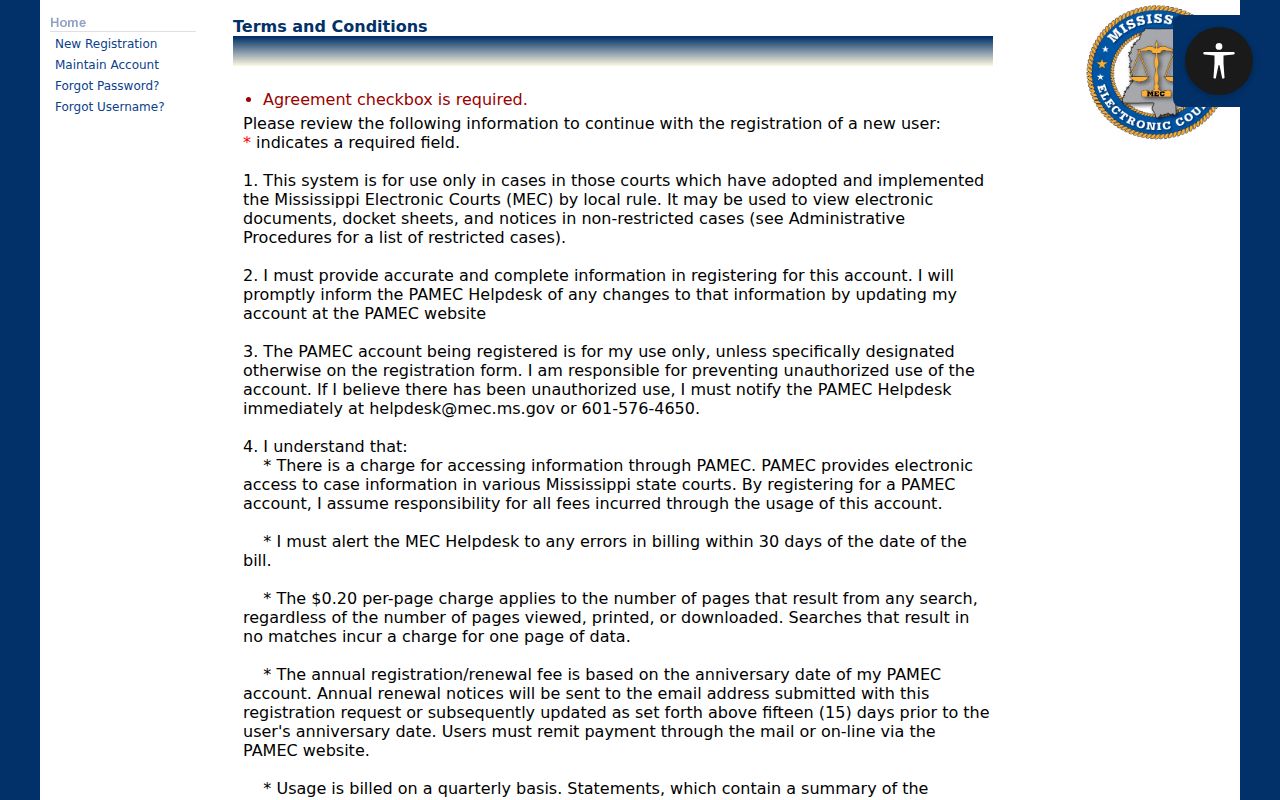
That page shows the terms, not a case result. Contact the Mississippi clerk who holds the file for plain or certified copies. Search pages are billed when generated. Opening a result is not required for the charge.